
Why Choose the Suzuki Method?
About the Suzuki Method
The Suzuki Method was developed by Japanese pedagogue Shinichi Suzuki in Japan in the 1940s. Suzuki teachers receive special teacher training which enables them to teach this method. Here are some of the core elements of the Suzuki Method listed below:
The Parent-Teacher-Child Triangle
Parental involvement is a crucial part of Suzuki violin lessons. The parent attends lessons and takes notes in order to lead practice sessions with the child at home, and better support the child’s broader musical development. Parental support is what guarantees success for a young child learning a complex musical instrument. Suzuki lessons are also an opportunity for parents to spend valuable time with their child in an educational setting.
Sound Before Sight
In Suzuki lessons, the teaching of note reading is delayed. This doesn’t mean that Suzuki pupils are not taught to read music, but simply that at the initial stages they are trained by ear. In this way, the child is able to focus first on learning to play their instrument without being overwhelmed by too many things at once. Learning to play by ear also means that children learn a remarkable amount of repertoire, meaning that they have many pieces at their fingertips – something which is greatly confidence-building.
Early Start
In order to get the most benefit from the Suzuki Method, Suzuki pupils start at a young age. I generally accept new violin pupils between the ages of 4 and 7. Our training enables Suzuki teachers to teach children before they have reached reading age.
Group Lessons
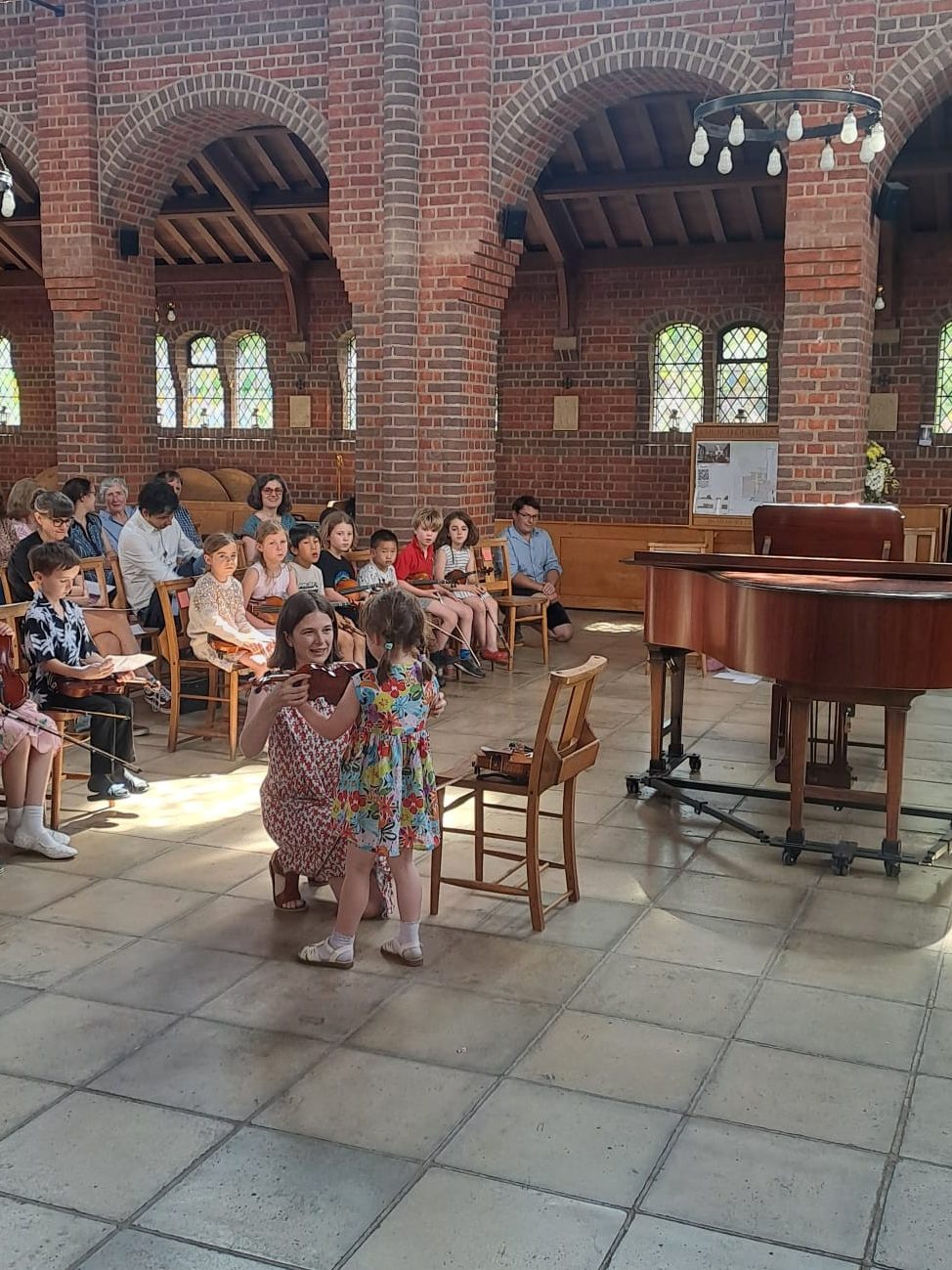
All Suzuki pupils partake in group lessons as well as individual lessons. Group lessons are a core part of the Suzuki method. They enable pupils to develop their musicianship and ensemble-playing skills, enjoy the social aspect of music-making, and have lots of fun! My group lessons take place 6 times termly.
A Positive Learning Environment
Creating a positive and safe learning environment is another important aspect of the Suzuki Method. This is done through regular praise, and breaking down skills into small achievable steps in order to set the child up for success.
During lessons, games, imagery, and a varied range of teaching tools are used to support pupils’ learning. The teaching approach is adapted to be developmentally appropriate for the child’s age and standard of playing.
During lessons, parents are also guided on how best to recreate this learning environment at home during practice time.
A Holistic Approach
The Suzuki approach is not just about creating violinists. Of course, if a pupil is interested in pursuing a career in music it’s highly encouraged, but creating professional musicians is not the sole aim of the Suzuki Method. The aim of the method is to nurture children through music, and cultivate in them a lifelong love and appreciation for this art form.
For more information, please visit the British Suzuki Music Association website: https://www.britishsuzuki.org.uk/pages/about-bsma
First Steps
If you are interested in Suzuki violin lessons for your child, I will first invite you to observe some individual and group lessons. Observers are also welcome to attend student concerts.
After the initial period of observation, I will arrange a meeting to discuss how Suzuki lessons work, my studio policy and lesson rates, availability for individual lessons and preparing the correct equipment for the first lesson.
I generally start pupils at the beginning of a new term.
Email:
Cambridge
 Iliana Marinov